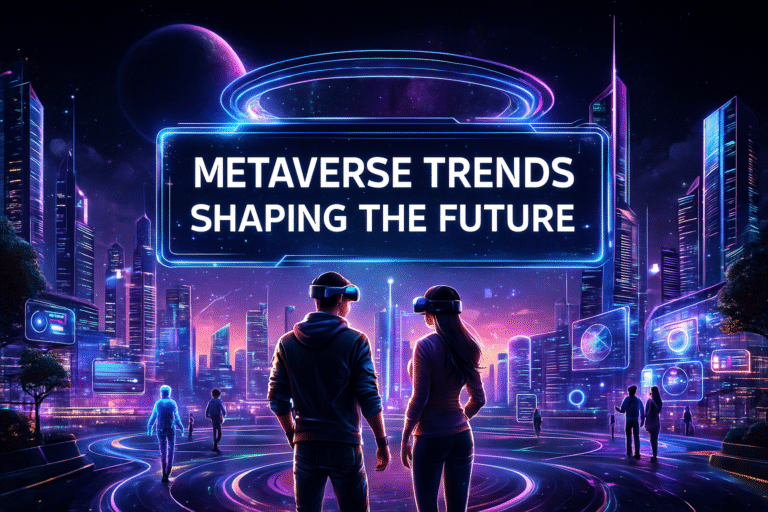
The metaverse is no longer just a buzzword — it is becoming one of the most important technological revolutions of our time. In 2025, the metaverse is evolving into a powerful blend of virtual reality (VR), augmented reality (AR), AI, blockchain, Web3, and digital economies. It is transforming the way people work, learn, play, socialize, shop, and interact.
This detailed guide explores the top metaverse trends shaping the future, the technologies behind them, and how they are impacting industries worldwide.
1. AI-Driven Metaverse Experiences
Artificial Intelligence is becoming the brain of the metaverse.
AI powers:
- realistic avatars
- smart NPCs
- physics simulations
- automated customer service
- personalized virtual worlds
- voice and gesture recognition
Why it matters
AI turns the metaverse from a static world into a smart, evolving universe.
In 2025, AI-powered assistants guide users, create content, and automate tasks inside virtual environments.
2. Hyper-Realistic Avatars
Gone are the days of cartoon-style characters.
Modern avatars include:
- face-tracking
- body-tracking
- emotion recognition
- lifelike expressions
- full 3D realism
Users want their avatars to truly represent who they are — or who they want to be.
Impact
- More natural communication
- Better digital identity
- Confidence and comfort in virtual meetings
Realistic avatars are becoming the new digital identity.
3. Interoperable Virtual Worlds
Before 2024, every metaverse platform was isolated.
In 2025, interoperability is a major trend:
- One avatar can move between virtual platforms
- Digital items can be used across different worlds
- Wallets and digital identity systems work everywhere
Projects like Metaverse Standards Forum, LayerZero, Polkadot, and Cosmos are connecting virtual worlds.
Why it matters
Interoperability creates a unified metaverse, not fragmented islands.
4. Mixed Reality (MR) Experiences
Mixed Reality blends the real and virtual worlds.
Devices like:
- Apple Vision Pro
- Meta Quest 3
- Samsung XR
- Microsoft HoloLens
…are making MR the new reality.
Examples of MR usage
- Virtual screens in real rooms
- 3D holograms for education
- Interactive workspaces
- Shared AR environments
- Real-world + digital fusion gaming
This is one of the biggest trends shaping daily life in 2025.
5. Virtual Workspaces & Remote Collaboration
Companies are shifting from video calls to virtual offices.
In the metaverse, teams can:
- meet in virtual rooms
- collaborate on 3D models
- brainstorm with digital tools
- attend events together
- work as avatars
Platforms like Horizon Workrooms, Spatial, and Microsoft Mesh lead this shift.
Why it matters
Remote work becomes more interactive, productive, and engaging.
6. Digital Twins of Cities & Industries
A “digital twin” is a virtual copy of something real.
In 2025, entire cities, hospitals, factories, and transportation systems have digital twins.
Uses of digital twins
- Smart city planning
- Traffic management
- Healthcare monitoring
- Building design
- Industrial automation
- Virtual testing and training
Digital twins create safer and more efficient real-world systems.
7. Metaverse Commerce & Virtual Shopping
Shopping is going fully immersive.
Brands now build virtual stores, where people can:
- explore products in 3D
- try clothes on avatars
- test furniture in virtual rooms
- buy digital + physical goods
Companies like:
- Nike
- Adidas
- Gucci
- Samsung
- Walmart
…are investing heavily in virtual retail.
Why it’s powerful
Metaverse shopping gives consumers a try-before-you-buy experience.
8. Web3 & Blockchain Integration
Blockchain ensures:
- user ownership
- secure identity
- digital asset trading
- transparent data
- decentralized control
The metaverse uses Web3 to power:
- virtual land
- NFTs
- digital identity
- in-game currencies
- tokenized economies
Why it matters
Users own their assets — not big corporations.
9. Metaverse in Education
2025 education is transforming through immersive learning.
Examples:
- virtual science labs
- historical simulations
- medical training
- engineering simulations
- interactive 3D classrooms
- VR field trips
Students retain more knowledge with immersive learning compared to traditional classrooms.
10. Metaverse Gaming Evolution
Gaming is the biggest part of the metaverse.
New possibilities include:
- cross-platform worlds
- token economies
- play-to-earn rewards
- avatar customization
- community-run games
- AI-generated gameplay
Games like Roblox, Fortnite, The Sandbox, and Star Atlas lead the change.
11. Creator Economy Growth
Creators can earn inside the metaverse by:
- building virtual spaces
- selling NFTs
- hosting events
- designing avatars
- selling digital items
- creating virtual experiences
Why this matters
Anyone can build a business inside the metaverse — no office required.
12. Health, Fitness & Wellness in the Metaverse
VR fitness apps are booming.
You can:
- join virtual gyms
- train with AI coaches
- participate in VR sports
- attend meditation rooms
This makes fitness fun and interactive.
13. Metaverse Events & Virtual Concerts
Concerts and events inside the metaverse attract millions.
Examples:
- Travis Scott VR concert
- Ariana Grande virtual tour
- Corporate expos
- Virtual conferences
- Community gatherings
These events break real-world limits of space and cost.
Conclusion
The metaverse is rapidly evolving and creating a new digital dimension where people can work, learn, shop, play, and interact in entirely new ways. With AI, blockchain, VR/AR, and digital identity becoming more advanced, the metaverse is shaping the future of the internet — and the real world.
Whether you’re a creator, business owner, student, gamer, or tech lover, understanding these trends will help you take advantage of incredible new opportunities.
About the Author